™
™

Both are Modbus. Both use the same function codes and register structure. But Modbus RTU and Modbus TCP are different enough that choosing the wrong one for your application creates real problems.
This is a practical guide — not a protocol deep-dive. The goal is to help you decide which one your application needs and why.
The Short Version
- Modbus RTU — serial, RS485 wiring, simple, the industrial standard for field devices
- Modbus TCP — over Ethernet, faster, more network-friendly, used in newer PLCs and DCS systems
If your devices have an RS485 port: Modbus RTU. If your devices have an Ethernet port: Modbus TCP. If you need to bridge between the two: you need a gateway that supports both.
Modbus RTU
How It Works
Modbus RTU runs over RS485 (or RS232 for point-to-point). It's a master-slave protocol — one master (your gateway or PLC) polls one or more slaves (meters, sensors, drives) in sequence.
The "RTU" refers to the framing: data is transmitted as raw binary with a CRC checksum. Timing between bytes matters — gaps in transmission are used to detect message boundaries.
Characteristics
| Parameter | Value |
|---|---|
| Physical layer | RS485 (2-wire differential) |
| Topology | Bus — up to 32 devices |
| Max distance | 1200m at 9600 baud |
| Baud rate | 1200 to 115200 bps (9600 most common) |
| Max devices per bus | 32 (with repeaters: more) |
| Message framing | Binary + CRC |
| Timing sensitivity | Yes — inter-character gap defines message boundary |
Where You Find It
Almost every industrial field device from the last 30 years has Modbus RTU: - Energy meters (Selec, Schneider, ABB, L&T) - Variable frequency drives (VFDs) - Temperature/pressure/flow transmitters - PLCs (older Siemens, Mitsubishi, Delta) - Older HVAC equipment (chillers, AHUs) - Solar inverters
Advantages
- Proven and ubiquitous. If it has an RS485 port, it speaks Modbus RTU.
- Simple wiring. Two wires (plus ground). No network switches, no IP addresses.
- Deterministic. Poll cycle time is predictable — no network congestion.
- Noise tolerant. RS485 differential signalling handles industrial EMI well.
- Long distances. 1200m on a single bus without repeaters.
Disadvantages
- One master per bus. Only one device can poll at a time. Two masters on one RS485 bus = collisions.
- Sequential polling. The master polls each slave one at a time. With 20 devices at 9600 baud, your poll cycle might take 10–15 seconds.
- Physical bus. Adding a device means running cable.
- No routing. You can't send Modbus RTU across a network.
Modbus TCP
How It Works
Modbus TCP takes the same Modbus function codes and register structure but wraps them in TCP/IP packets. It runs over standard Ethernet. The binary RTU framing is replaced with a TCP/IP wrapper (MBAP header).
No checksum in the payload — TCP handles error detection. No timing constraints — TCP is connection-oriented.
Characteristics
| Parameter | Value |
|---|---|
| Physical layer | Ethernet (10/100/1000 Mbps) |
| Topology | Network (star via switch) |
| Max distance | Standard Ethernet (100m per segment) |
| Port | TCP port 502 |
| Max devices | Limited by network infrastructure |
| Message framing | MBAP header + PDU |
| Timing sensitivity | No |
Where You Find It
Newer industrial equipment increasingly uses Modbus TCP: - Modern PLCs (Siemens S7-1200/1500, Mitsubishi iQ-R, Schneider M241) - Industrial PCs and HMIs - Network-attached instruments - Smart switchgear and protection relays - SCADA servers polling via Ethernet
Advantages
- Multiple masters. Multiple clients can connect to the same Modbus TCP server simultaneously — SCADA, historian, and gateway all reading the same PLC at the same time.
- Standard network infrastructure. Uses existing Ethernet switches and cabling.
- Faster. 100 Mbps vs 115 kbps at the top end.
- Routable. Can traverse routers and VPNs — Modbus data can cross the enterprise network.
- No bus topology limitation. Each device connects to the network switch individually.
Disadvantages
- Requires network infrastructure. Ethernet switches, IP addressing, network management.
- Not available on most field devices. Your old energy meters and VFDs don't have Ethernet ports.
- IT/OT security concern. Modbus TCP has no authentication. If it's on an accessible network, any device can read or write to it.
- Latency unpredictability. Network congestion can affect polling — less deterministic than RS485 in congested environments.
The Register Model is Identical
This is the important point: the same registers, function codes, and data model work in both variants. If your device documentation says "Holding Register 0x0000 = Voltage", that register works the same whether you're accessing it via RTU or TCP.
The difference is purely in how the request gets delivered to the device — over RS485 serial or over Ethernet TCP.
This means: - A device that supports both (some modern PLCs do) can be read via either method - Your BusLog profile configurations work regardless of which variant you're using - If you know Modbus RTU, you already know Modbus TCP — same registers, same function codes
Modbus TCP to RTU Bridging
Many real-world installations have both. A factory might have: - Old energy meters and VFDs on RS485 (Modbus RTU) - A new PLC with Ethernet (Modbus TCP) - A SCADA system that wants to read all of them
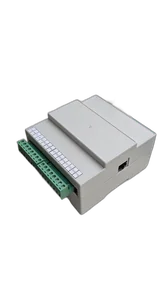
This is where a gateway with both capabilities matters. The BusLog IO UNI v1 supports both Modbus RTU (RS485) and Modbus TCP (Ethernet) simultaneously — it can read from RTU slaves and make that data available to a Modbus TCP master, or push all data to a cloud platform via MQTT.
Decision Framework
Use Modbus RTU when: - Your devices have RS485 ports (meters, sensors, drives, older PLCs) - You need long cable runs (>100m without additional infrastructure) - Your installation has no Ethernet network - You want simple, no-network-management wiring - You have field devices in remote or outdoor locations
Use Modbus TCP when: - Your devices have Ethernet ports (newer PLCs, industrial PCs) - You already have Ethernet infrastructure on the floor - Multiple systems need to read the same device simultaneously - You need data to cross a network (across buildings, to an enterprise system) - Your PLC vendor's tooling uses Modbus TCP as the standard interface
You need both when: - You have a mix of old RS485 field devices and newer Ethernet-connected PLCs - Your SCADA is on the enterprise network but your meters are on RS485 - You're building a data concentrator for a complex site
Summary
Modbus RTU and Modbus TCP are both Modbus — same registers, same function codes, different wiring. RTU is the field device standard: simple, proven, works over RS485 cable at 9600 baud. TCP is the network-connected variant: faster, multi-master, used in modern PLCs and network-attached devices.
Look at your device's physical interface: - RS485 port → Modbus RTU - Ethernet port → Modbus TCP - Both → your gateway should support both
For most industrial monitoring applications with field devices, you're dealing with Modbus RTU. For PLC integration and SCADA connectivity, Modbus TCP increasingly matters.
Need a gateway that handles both? See the BusLog IO UNI or contact us to discuss your setup.