Every industrial IoT deployment in India needs a SIM. And every deployment eventually has a connectivity problem that traces back to the wrong SIM choice. This guide covers what actually matters when picking a carrier and plan for field-deployed gateways — not what the carrier's sales brochure says.
What Makes Industrial IoT Different From a Smartphone
Your phone reconnects automatically when it drops signal, routes around congestion, and you're there to notice when something's wrong. A gateway in a pump station 40 km away is not your phone.
Industrial IoT connectivity requirements: - 24/7 uptime — device needs to connect reliably, not just when a tower isn't congested - Low data volume — most gateways send a few KB per upload, not streaming video - Remote locations — factory rooftops, pump stations, substations, pipeline junctions - Unattended operation — if the SIM gets blocked, NAT'd behind CGNAT, or throttled, you find out days later - Inbound connectivity (sometimes) — if you need to push config changes or commands to the device, you need a reachable IP
Carrier Coverage in India — Real-World Notes
Airtel
Best overall for industrial IoT in India. Reasons: - Most extensive tower density in tier-2 and tier-3 cities - Better signal penetration in fringe areas compared to Jio - Enterprise M2M plans available with dedicated APN - More stable signal in indoor/basement installations - Static IP available on enterprise plans (important — see below)
Works well for: Manufacturing plants in semi-urban areas, water utilities on city outskirts, commercial buildings
Struggles with: Dense forested areas, specific rural talukas — check coverage map before committing to a deployment
Jio
Best for data pricing. Network built on 4G-only (no 2G/3G fallback), which is generally fine for IoT.
- Cheapest prepaid data rates in the country
- Coverage now nearly matches Airtel in most urban and semi-urban areas
- Rural coverage still lagging in some states (Rajasthan interior, J&K, Northeastern states)
- M2M/IoT plans available but static IP only on enterprise JioThing plans — harder to get
- Weak signal at fringe areas compared to Airtel — IoT devices that barely register signal on Airtel may not connect at all on Jio
Works well for: Urban/semi-urban deployments where Jio coverage is strong and cost is a priority
Struggles with: Remote rural sites, anything where you need a static IP easily
BSNL
Often overlooked. BSNL has excellent rural coverage (government mandate) and is the right choice for genuinely remote sites — agricultural pumps in villages, substations in rural areas, pipeline monitoring in the middle of nowhere.
- 4G still rolling out (2025–26), but 3G is widespread where 4G is missing
- Static IP SIMs available via BSNL commercial plans, and they're not expensive
- Bureaucratic to get — best to work with a BSNL dealer rather than online
- Data speeds are lower than Airtel/Jio but IoT doesn't need speed — it needs uptime
Works well for: Remote rural deployments, off-grid sites, government projects requiring BSNL
Vi (Vodafone-Idea)
Avoid for new deployments where possible. Vi's network quality has declined significantly post-merger struggles, particularly: - Many towers decommissioned in overlap areas - 4G coverage shrinking, especially in tier-2/tier-3 - Unpredictable reliability for 24/7 uptime requirements - M2M plans exist but support infrastructure is inconsistent
If you already have Vi SIMs deployed, monitor link uptime carefully. Plan migration as contracts renew.
Static IP vs Dynamic IP — Why It Matters
Most SIM cards in India use CGNAT (Carrier Grade NAT). Your gateway gets a private 10.x.x.x address that's shared with thousands of other subscribers. You cannot reach it from the internet — you can only connect outbound.
For most IoT use cases (MQTT/HTTPS push), CGNAT is fine. The device pushes data to your server. You don't need to reach the device.
You need a static IP (public IP) when: - You need to SSH or HTTP into the gateway for remote configuration - Your platform pulls data from the device (Modbus TCP poll from cloud) - You're running a VPN where the device is the server endpoint - You want to verify the device is reachable without going through the data platform
Getting a Static IP in India
| Carrier | How to Get Static IP | Cost |
|---|---|---|
| Airtel | Enterprise M2M plan via Airtel Business | ₹100–200/SIM/month premium |
| Jio | JioThing enterprise plan (direct or via partner) | Enterprise pricing |
| BSNL | BSNL commercial/landline internet package or M2M plan | Reasonable, ask the local exchange |
| Airtel (alternative) | OpenVPN to your server, gateway as client | Free — but your server needs to be reachable |
The VPN alternative is often better than a static IP. Deploy OpenVPN or WireGuard on a VPS, configure the gateway as a client. The gateway calls out, you have a persistent tunnel in. Works on any carrier behind CGNAT.
Data Plans for IoT
You don't need much data. Here's what a typical BusLog gateway uses:
| Upload interval | Data per upload | Monthly usage (est.) |
|---|---|---|
| 1 minute | ~0.5 KB | ~20 MB |
| 5 minutes | ~0.5 KB | ~4 MB |
| 30 minutes | ~0.5 KB | ~0.7 MB |
| 1 hour | ~0.5 KB | ~350 KB |
Even at 1-minute intervals, you're under 25 MB/month per device. Add firmware updates over 4G and double it — 50 MB/month is sufficient for most deployments.
Recommended plan options:
Jio Prepaid: ₹21/month for 1 GB, ₹49/month for 2 GB — more than enough per device. Recharge via API or JioPay for automation. Problem: they expire if not recharged in time and the number gets deactivated. Set a calendar reminder or use auto-recharge.
Airtel M2M: ₹50–150/month depending on plan, commercial billing, dedicated support, SIM doesn't expire as long as billing is active. Recommended for deployments of 10+ devices.
BSNL M2M: Enquire locally. Pricing is regional. Often ₹75–150/month with static IP included.
Avoid: Prepaid plans with daily expiry that require daily data activation. Some ₹2/day packs work like this — fine for phones, terrible for gateways that you can't manually activate daily.
Signal Quality at Your Site
Before ordering 50 SIMs, test first.
Quick test: Take your phone to the site. Switch it to the network you're evaluating (turn off WiFi, set preferred network to 4G only). Place it where the gateway antenna will be. Note:
- Signal bars (rough guide only)
- Whether RSRP is visible (use *#*#4636#*#* on Android → Phone information → run ping test to see LTE signal)
- Actually try to load a page and watch the latency
RSRP < -110 dBm means marginal signal. At -120 dBm you'll have frequent disconnections. Gateways with external antennas handle weak signal better than phones, but the baseline needs to be usable.
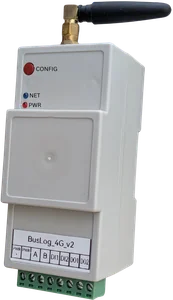
Antenna placement matters more than carrier choice in borderline sites. A high-gain external antenna (5–9 dBi) on the roof versus the gateway's internal patch antenna can be the difference between reliable connectivity and constant timeouts. Most BusLog gateways have an SMA connector for external antenna.
Auto APN — No Configuration Needed
One question we get repeatedly: "What APN do I set for Airtel / Jio / Vi?"
BusLog gateways auto-detect the APN from the SIM. Insert any Indian SIM and the gateway will configure the APN automatically — you don't need to set it manually for Airtel, Jio, Vi, or BSNL.
Manual APN entry is only needed for: - Private enterprise APNs (when your company has a dedicated APN from the carrier) - Roaming configurations - Some BSNL commercial plans with custom APNs
SIM Management at Scale
For 20+ devices, these become real operational concerns:
Track which SIM is in which device: Keep a spreadsheet — SIM number, phone number (for SMS alerts), IMEI of the gateway it's in, installation site, recharge date. You will need this when a SIM stops working and you can't remember which one.
Recharge automation: Set up auto-recharge where the carrier supports it. Airtel M2M billing is automatic. For prepaid Jio/Airtel consumer SIMs, use the carrier app's autopay feature.
SMS for debugging: Most carriers allow you to send an SMS to the gateway's SIM number. Some BusLog firmware versions respond to SMS commands — useful for forcing a reconnect when the device isn't reachable any other way.
SIM health monitoring: Your cloud platform should log each device's last-seen timestamp. A device that hasn't uploaded in 4 hours when it normally uploads every 5 minutes needs attention — could be a SIM issue, power issue, or hardware fault.
Recommendation Summary
| Site Type | Recommended Carrier |
|---|---|
| Urban / industrial estate | Airtel (reliability) or Jio (cost) |
| Semi-urban / tier-2 city | Airtel |
| Rural / remote / agriculture | BSNL, then Airtel |
| Need static IP, easy setup | Airtel M2M enterprise |
| Need static IP, budget | BSNL M2M or VPN workaround |
| High device count, predictable billing | Airtel M2M or Jio enterprise |
| Avoid | Vi for new deployments |
Test before you commit. One test SIM at the site is worth more than any coverage map.
Get M2M SIMs Directly from SilTech
If you're deploying BusLog gateways, you can source M2M SIMs directly from us. SilTech is a DoT-registered M2M Service Provider under Sanchar Saathi — meaning compliant, enterprise-grade connectivity with proper static IP and private APN provisioning.
What's included: - Airtel M2M network (others on request) - Plans starting at 120MB data + 200 SMS/month - Static IP available - Private APN for enterprise/utility deployments - Bulk management portal - SIM activation integrated into the BusLog platform
Single vendor for hardware and connectivity. Contact us for a quote.